On Page SEO Tools: How To Apply AI For Keywords, Content, And UX
Marcela De Vivo
Marcela De Vivo
March 11, 2026
SEO has always been a crucial aspect of digital marketing, but the way we optimize content has changed dramatically with the rise of artificial intelligence. AI has transformed on-page SEO from a manual, time-consuming process into a streamlined, data-driven strategy that adapts to search engine algorithms in real time.
Before AI: How on page seo tools replaced manual, reactive workflows
In the past, SEO specialists relied on manual keyword research and best-guess content optimization. They would spend hours analyzing search trends, carefully placing keywords, and adjusting meta descriptions based on trial and error. Content was crafted entirely by human writers, and internal linking required a strategic but often inefficient approach.
Adapting to search engine updates was slow and reactive, as marketers had to analyze rankings, identify changes, and manually adjust their strategies. Data insights were limited, and decisions were often based on periodic analytics reviews rather than real-time performance tracking.
How AI changed on page seo tools and SEO workflows
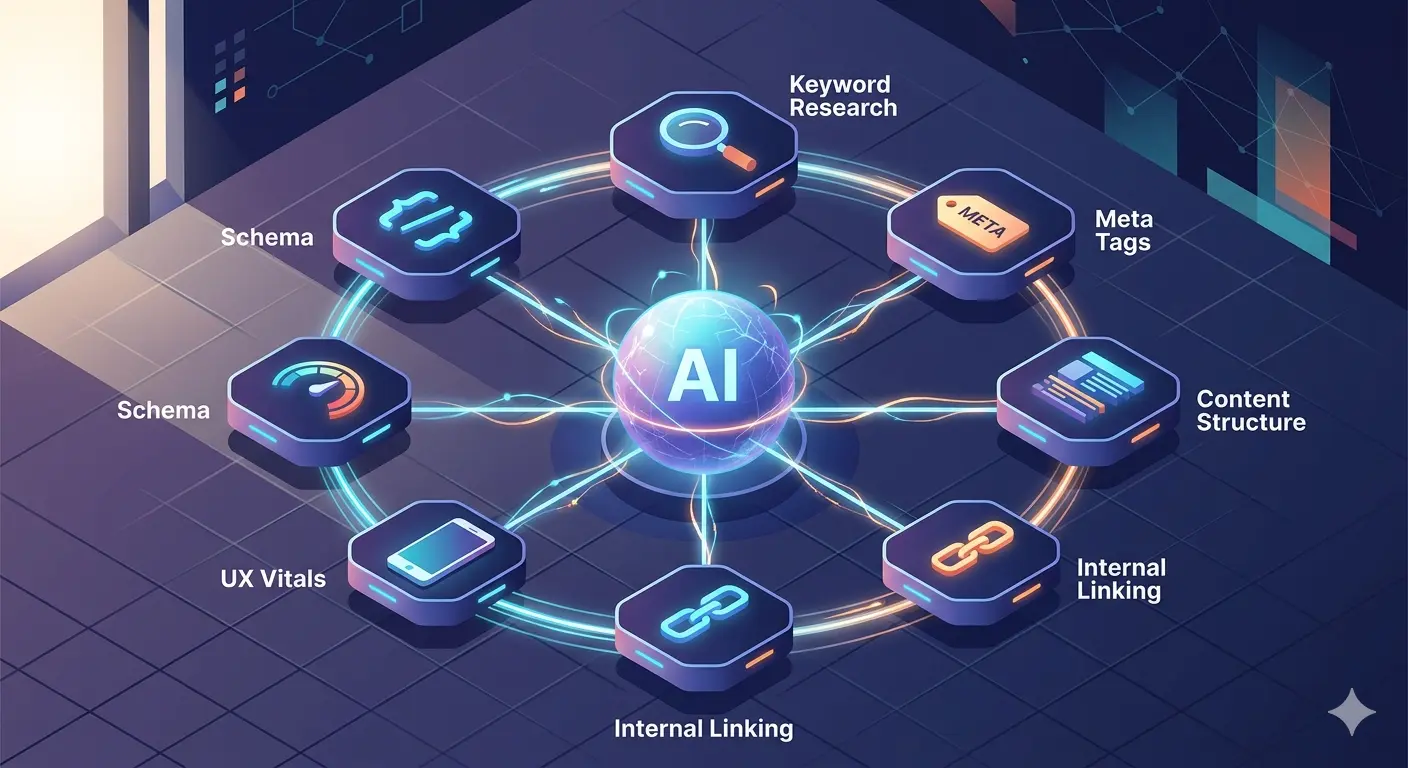
Today, AI has changed the game. With powerful automation tools, content can now be optimized dynamically based on user intent and search trends. AI-powered platforms like Gryffin integrate real-time keyword research directly into content creation, ensuring that every piece is optimized before it even goes live.
AI doesn’t just generate content—it enhances it. It can rewrite articles for better readability, suggest structural improvements, and even optimize for voice search by recommending conversational phrases. Meta descriptions, title tags, and headers are no longer static; AI tools continuously refine them based on evolving search engine algorithms.
Internal linking has also become smarter. AI can detect link opportunities, recommend the best placement for SEO, and continuously provide suggestions for improved connectivity between content pieces.
Below are some key ways AI enhances On-Page SEO and the tools that make it possible.
How to do keyword research with on page seo tools
Traditional keyword research is time-consuming and often requires manual analysis of search trends, competitor data, and ranking difficulty. AI-driven tools automate this process by analyzing massive datasets in real-time and identifying the most relevant, high-impact keywords.
How AI enhances keyword research in on-page SEO tools
Finds long-tail keywords based on search intent.
Analyzes competitor keywords to identify ranking opportunities.
Example: Run an AI keyword analysis for “AI in marketing”
A content marketer wants to write a blog about “AI in marketing.” Instead of manually searching for keywords, AI tools can:
Analyze top-ranking content to identify common keywords used in high-performing articles.
Suggest long-tail variations like “How to use AI for marketing automation” or “Best AI tools for digital marketing”.
How to write meta titles and descriptions with on page seo tools
Meta tags (title tags, meta descriptions, and header tags) are critical for On-Page SEO as they help search engines understand the page's content and improve click-through rates (CTR).
How AI improves meta tag optimization in on-page SEO tools
A/B tests different meta descriptions to identify high-performing variations.
Uses sentiment analysis to craft emotional, engaging meta descriptions.
Example: From “Learn AI for SEO” to an AI‑optimized description
Instead of manually writing meta descriptions for every page, AI can generate:
Before:“Learn AI for SEO.”
After (AI-optimized):“Boost your rankings with AI-powered SEO! Learn how to automate keyword research, optimize content, and improve user experience.”
By A/B testing AI-generated meta tags, businesses can increase CTR and drive more organic traffic.
How to optimize content quality with on page seo tools
Content is the core of On-Page SEO, but not all content ranks well. AI tools analyze keyword density, readability, and engagement metrics to ensure content aligns with Google’s ranking factors.
How to use AI content scoring inside on-page SEO tools
Content scoring tools analyze SEO-readiness based on top-ranking content.
Natural Language Processing (NLP) ensures content is human-like and engaging.
AI identifies missing topics and suggests content structure improvements.
AI checks keyword usage and recommends optimization tweaks.
Example: Close topic gaps for “How AI helps SEO”
A blog post about “How AI helps SEO” might be underperforming due to missing important subtopics. AI tools can:
Analyze the top 10 search results and identify topics covered by competitors but missing in your content.
Recommend adding FAQs, statistics, or case studies for better ranking potential.
Provide a content score (e.g., 80/100, with suggestions to improve readability and engagement).
AI ensures every blog post is optimized to rank higher and perform better in search results.
How to build internal links with on page seo tools
Internal linking helps distribute link equity across pages, improves crawlability, and boosts SEO rankings.
How AI detects link opportunities and anchor text
Identifies the best internal linking opportunities based on content relevance.
Prevents orphan pages (pages with no internal links).
Suggests anchor text optimization for better SEO impact.
Example: Add links from “AI for digital marketing” to related posts
An AI tool detects that a blog post about "AI for digital marketing" has no internal links. It suggests:
Linking to a related article about AI in social media using descriptive anchor text (e.g., “Learn how AI improves social media marketing.”).
Prioritizing high-ranking pages to distribute SEO authority effectively.
How to improve Core Web Vitals with on page seo tools
Google now considers Core Web Vitals (page speed, mobile-friendliness, and interactivity) in rankings. AI improves UX by analyzing user behavior and providing actionable insights.
How AI pinpoints UX issues that affect on-page SEO
AI tools analyze page speed and recommend fixes.
AI-powered heatmaps show how users interact with a page.
Predictive analytics identify user drop-off points.
How AI suggests and validates schema for on-page SEO
Automatically generates structured data based on content.
Ensures schema implementation is error-free.
Helps content appear in rich snippets, increasing CTR.
Example: Add FAQ schema to win rich results
An AI-driven tool scans a blog post and suggests:
Adding FAQ schema to improve visibility in Google’s rich results.
Applying Review schema for better engagement.
Fixing schema errors to prevent SEO penalties.
AI is revolutionizing On-Page SEO by automating optimizations, improving accuracy, and enhancing efficiency. By leveraging AI for keyword research, content optimization, internal linking, UX, and schema markup, websites can rank higher, attract more traffic, and convert better.
Future trends: How AI will shape on page seo tools and tactics
Artificial Intelligence (AI) is already transforming On-Page SEO, but the advancements we see today are just the beginning. As AI-driven search engine algorithms continue to evolve, SEO professionals and content creators must adapt to new ways of optimizing web pages for search rankings, user engagement, and content relevance.
With machine learning, natural language processing (NLP), and automation improving at an unprecedented rate, here’s what the future holds for AI in On-Page SEO.
1. How AI ranking systems change on-page SEO priorities
Google’s AI-powered ranking algorithms like RankBrain, BERT, and MUM have already revolutionized how content is indexed and ranked. These machine learning models understand search queries, content, and user behavior far better than traditional keyword-based ranking systems.
What’s Next?
Google’s AI will prioritize user intent over exact-match keywords – Traditional keyword optimization will become less important as AI models shift toward understanding search intent and context more effectively.
AI-powered ranking factors will evolve dynamically – Google and other search engines will use real-time machine learning adjustments to rank pages based on search behavior trends and engagement metrics.
SEO will become more predictive – AI-driven algorithms will anticipate trends and optimize content before search demand peaks.
Example:
Instead of relying on keyword density, Google’s AI will assess content relevance, depth, and topical authority based on real-time search behavior and past interactions.
Websites that focus on creating truly helpful, user-focused content will rank higher than those that merely optimize for specific keywords.
2. How to use AI writing safely within on page seo tools
Currently, AI-generated content is efficient but sometimes lacks originality and depth. However, future AI-driven content generation models will be virtually indistinguishable from human writing.
What’s Next?
AI will generate content that mimics human creativity, tone, and storytelling.
AI-assisted content will be personalized in real-time based on user preferences and past behavior.
AI will dynamically optimize content structure for SEO, engagement, and readability.
Example:
AI-generated blog posts, landing pages, and product descriptions will adapt dynamically based on search trends and audience behavior.
AI tools like Gryffin AI will automatically rewrite and optimize content to fit Google’s ranking priorities in real-time.
3. How to optimize for voice search with on page seo tools
With the rise of voice assistants (Google Assistant, Alexa, Siri) and smart devices, voice search optimization is becoming a key component of On-Page SEO. AI is changing how users search—moving from typed queries to natural, conversational questions.
What’s Next?
AI will optimize content for voice search queries, long-tail phrases, and conversational search.
Search engines will prioritize “direct answers” and “featured snippets” optimized for spoken queries.
AI-powered chatbots and virtual assistants will integrate with SEO strategies to provide instant, interactive answers to search queries.
Example:
Instead of ranking for “best SEO tools 2025”, AI will prioritize content that answers “What are the best SEO tools for small businesses in 2025?” in a conversational, easy-to-understand format.
4. Guide: Deliver variant content by device, location, and history
AI will personalize search results based on user behavior, location, and past interactions. This means two users searching for the same keyword may see completely different search results based on their preferences.
What’s Next?
AI will customize website content in real-time for different visitors.
Personalized SERP (Search Engine Results Pages) results will vary based on past searches, device type, and search history.
AI-powered SEO strategies will focus on individual user experiences rather than general optimization techniques.
Example:
A returning visitor to an e-commerce website might see different product recommendations or blog content than a first-time visitor, based on their past interactions.
5. How to automate on-page SEO tasks with AI tools
AI will automate nearly every aspect of On-Page SEO, from keyword research to content optimization and internal linking. This will allow marketers and SEO professionals to spend less time on manual tasks and more time on strategy.
What’s Next?
AI will automatically optimize meta tags, content structure, and schema markup.
AI-powered SEO tools will adjust On-Page SEO elements dynamically as ranking algorithms change.
AI will integrate with Google Search Console and analytics tools to provide automated SEO recommendations.
Example:
AI-driven SEO tools will detect and fix broken links, optimize alt text for images, and automatically update outdated content—without human intervention.
6. How to use predictive models to plan on-page SEO content
AI will not only analyze existing search patterns but will also predict future SEO trends based on emerging topics, industry shifts, and real-time search behavior.
What’s Next?
AI will forecast the next big search trends before they happen.
Businesses will use predictive SEO models to optimize content in advance of demand spikes.
AI will suggest new content topics based on rising search patterns before competitors identify them.
Example:
AI tools will detect a growing trend in “AI-powered eCommerce tools” before the competition catches on—allowing websites to create content around that topic early and dominate rankings before demand peaks.
7. How to optimize images and video with on page seo tools
With video and visual search becoming more dominant, AI will optimize video content, alt text, and structured data to help websites rank in image and video search results.
What’s Next?
AI will automatically generate video transcriptions and closed captions for better SEO.
AI will optimize image alt text, filenames, and metadata for higher rankings in Google Images.
AI-powered image recognition technology will enhance searchability of visual content.
Example:
AI tools will analyze which frames of a video are most engaging and suggest the best video thumbnails for SEO rankings.
How to use Gryffin as your on page seo tools hub
Gryffin isn’t just another SEO tool—it’s an AI-powered marketing automation platform designed to streamline and enhance your on-page SEO workflow. With Gryffin, you can:
Generate SEO-Optimized Content – Use Gryffin’s AI-powered content generation tools to create blog posts, landing pages, and product descriptions that align with best SEO practices.
Automate Keyword Integration – Gryffin helps you seamlessly insert the right keywords, meta descriptions, and headers into your content, ensuring it's optimized without compromising readability.
Refine Content with AI-Powered Insights – Gryffin doesn’t just generate content; it analyzes your inputs and refines them for maximum engagement, readability, and performance.
Stay Ahead of Algorithm Changes – With AI-driven analytics and reporting, Gryffin provides insights into what’s working and what needs improvement, so your content remains competitive.
For SEO specialists, agencies, and digital marketers, Gryffin is the ultimate AI-powered solution to automate and optimize on-page SEO strategies—all while saving time and improving content performance.
Q: How has AI changed on-page SEO compared to the old manual approach? A: AI replaces guesswork and slow, manual updates with real-time, data-driven optimization. It automates keyword research, generates and refines meta tags, improves content quality and structure, and surfaces internal linking opportunities. AI also analyzes UX signals, fixes schema, and adapts to ranking shifts faster than human-only workflows.
Q: Step-by-step: How do I use AI tools to find long-tail, semantic, and trending keywords for a new article? A: Start by having an AI tool analyze top-ranking pages for your topic to extract common themes and terms. Use it to surface long-tail variations aligned with search intent and suggest semantic (LSI) keywords that add depth. Add competitor keywords to find gaps, then apply trend predictions to prioritize terms likely to gain traction. Cluster the final set to shape your outline before drafting.
Q: Can AI write and A/B test meta titles and descriptions? Share examples and how to run the test. A: Yes—AI can generate keyword-rich titles and descriptions, apply sentiment analysis, and A/B test variants to improve CTR. Example: Before: “Learn AI for SEO.” After: “Learn AI-powered SEO to automate research, optimize content, and improve user experience.” To test, create multiple AI variants, rotate them or use a testing tool, track CTR and rankings, then deploy the winner and iterate.
Q: My article on AI and marketing isn’t ranking—how can AI analyze competitors and suggest missing subtopics, FAQs, and structure fixes? A: Use AI to audit the top results, identify covered subtopics you missed, and compare content depth and readability. It will recommend adding sections like FAQs, statistics, or case studies, reorganize headers for clarity, and suggest conversational phrasing for voice search. Many tools also score the draft and flag optimization tweaks for keyword coverage and engagement.
Q: What’s the best way to use AI for internal linking, anchor text suggestions, and preventing orphan pages? A: Have AI crawl your site to map topical relationships and propose links from relevant pages. It will suggest descriptive anchor text, prioritize links from higher-authority pages, and surface orphan pages that need connections. Review the recommendations, implement the highest-impact links first, and rerun the tool regularly to keep the structure current.
Q: High bounce rate and slow pages: how can AI diagnose Core Web Vitals issues and recommend actions like image compression, lazy loading, and clearer CTAs? A: AI can analyze page speed, interaction, and layout stability alongside heatmaps and click data to find friction points. It often recommends compressing images to WebP, lazy loading heavy scripts, and simplifying navigation and CTAs. Pair those fixes with monitoring to confirm faster loads, longer sessions, and higher engagement.
Q: How do I prepare for the future of AI-driven rankings (RankBrain, BERT, MUM), personalization, and predictive SEO? A: Focus on user intent, topical depth, and genuinely helpful content rather than exact-match keywords. Use AI to structure pages for rich results, maintain clean schema, and update meta elements dynamically. Add predictive SEO to plan content ahead of rising trends, and personalize on-page experiences where possible.
Q: How can I optimize content for voice search and conversational queries using AI insights? A: Use AI to surface natural, question-based queries and conversational phrases users speak. Structure concise, direct answers that can win featured snippets, and add FAQ sections supported by FAQ schema. Keep headings clear, sentences scannable, and language natural to align with spoken search patterns.
Q: How can AI improve video and image SEO, including captions, alt text, filenames, and thumbnail selection? A: AI can auto-generate accurate video transcriptions and captions, making content more discoverable. It also writes descriptive image alt text, suggests SEO-friendly filenames and metadata, and picks engaging, high-CTR thumbnails. Image recognition further improves tagging and helps content appear in visual search.
Q: What can Gryffin AI do to automate on-page SEO tasks like content generation, keyword integration, internal linking, and analytics? A: Gryffin generates SEO-ready content and seamlessly integrates keywords, meta descriptions, and headers without harming readability. It refines drafts with AI-driven insights, recommends internal links, and surfaces ongoing optimization opportunities. With analytics and reporting, it helps you adapt to algorithm changes and prioritize high-impact tasks.
At first, we weren’t even thinking about AI visibility. We were focused on rankings and traffic like everyone else. But once we started testing our brand in ChatGPT and other AI tools, we realized we were barely showing up — even for topics we ‘ranked’ for. Gryffin gave us a clear picture of where we stood, how competitors were being cited instead, and what that actually meant for our pipeline. It shifted how we think about search entirely.










.png)
.svg)
.svg)
.svg)


