AI SEO Search Intent: How to Build Semantic, Predictive SEO
Marcela De Vivo
Marcela De Vivo
March 11, 2026
SEO has long revolved around keywords—finding the right ones, stuffing them into content, and hoping to rank. But the search game has changed. Today, AI doesn’t just help marketers find keywords; it deciphers intent, context, and meaning behind every search.
Search engines, led by Google’s RankBrain, BERT, and MUM, now understand user intent better than ever. Traditional SEO tactics like keyword density and exact-match phrases are no longer enough. Instead, AI is ushering in semantic SEO, intent optimization, and predictive search—forcing brands to think beyond mere words and focus on real user needs.
How AI SEO search intent replaces keyword-first tactics
This article explores how AI is transforming search intent and SEO, covering:
How AI deciphers search intent and context
The rise of semantic SEO and predictive search
AI’s role in optimizing for voice, visual, and conversational search
Guide to AI SEO search intent and contextual ranking
Search intent is the why behind a query. Before AI, search engines relied on keywords alone. Now, Google and other platforms leverage deep learning, natural language processing (NLP), and context analysis to understand what users really mean.
AI’s Role in Understanding Search Intent
Instead of just looking for words on a page, AI examines multiple layers of intent, including:
Implicit Signals: Device type, location, search history, and user behavior.
User Intent Layers:
Informational: “What is semantic SEO?”
Navigational: “Gryffin AI homepage”
Transactional: “Buy AI SEO software”
Comparative: “Best AI SEO tools vs. manual SEO”
Context Awareness: AI recognizes the difference between identical keywords in different contexts. Example:
“Apple” (fruit) vs. “Apple” (company)
“Jaguar” (car) vs. “Jaguar” (animal)
Google’s AI-Powered Intent Matching
BERT (2019): Helps search engines understand natural language context, not just individual words.
MUM (2021): A multimodal AI that processes text, images, and video simultaneously, making it more conversational and intent-focused.
RankBrain: Analyzes how users interact with search results, refining rankings in real time.
What This Means for Marketers
Exact-match keywords are dead—focus on clusters of related terms instead.
Content should match user needs, not just include keywords.
On-page SEO must include context-rich cues, like entity relationships and structured data.
How to implement semantic SEO for AI SEO search intent
What is Semantic SEO?
Semantic SEO moves beyond keyword matching to focus on topic relevance, relationships between entities, and content depth.
AI and Semantic Search
AI-driven algorithms analyze:
Latent Semantic Indexing (LSI): Related words and phrases that help define a topic.
Entity Recognition: Connecting key subjects, people, brands, and concepts.
Search Journey Mapping: Understanding how users move from broad queries to specific actions.
How AI Optimizes for Semantic SEO
Semantic SEO is revolutionizing search, moving beyond keyword-based rankings to a more context-aware and intent-driven approach. AI is at the forefront of this evolution, helping businesses not just analyze keywords but also understand relationships between concepts, entities, and user intent.
Below, we explore the three key ways AI optimizes for semantic SEO, ensuring content remains relevant, discoverable, and future-proof.
1. Dynamic Content Adjustments: AI-Powered Optimization in Real Time
One of the biggest challenges with traditional SEO is the static nature of content optimization. Once an article is published, marketers often wait for months to analyze its performance and adjust based on new ranking factors.
AI eliminates this lag by continuously monitoring top-performing pages, keyword trends, and user behavior, enabling real-time content adjustments.
How It Works:
AI tools analyze top-ranking pages: Platforms scrape the SERPs (Search Engine Results Pages) to identify the semantic terms, related entities, and phrase patterns used in high-ranking content.
Automated content scoring: AI assigns content scores, highlighting gaps and missing subtopics that could improve rankings.
AI-driven content rewriting: Some tools even suggest or generate missing sections to enhance comprehensiveness.
Adaptive optimization: AI adjusts content dynamically as search behavior shifts, ensuring your pages stay optimized for evolving algorithms.
Real-World Example:
A SaaS company using AI-driven content tools found that their article on “AI Marketing Automation” was missing key phrases like “machine learning in digital marketing” and “predictive analytics tools”. By following AI-driven suggestions, they updated their article dynamically, improving rankings and organic traffic by 42%.
Actionable Takeaway:
Analyze top-ranking pages and get AI-driven suggestions for content gaps.
Regularly update content based on AI-powered keyword analysis rather than relying on outdated manual audits.
Implement AI-driven content refreshes to maintain rankings without starting from scratch.
Google no longer ranks pages solely based on single keyword targeting—instead, it evaluates the depth and breadth of coverage on a topic.
This means individual articles can no longer thrive in isolation—instead, brands need well-structured topic clusters that signal expertise and authority. AI automates this process by identifying content relationships and structuring topic hierarchies.
How AI-Driven Content Clustering Works:
AI identifies semantic relationships between related topics and recommends a hierarchical structure.
Topic cluster modeling: AI helps group related content pieces into pillar pages and supporting articles—a process that manual research could take weeks to complete.
Internal linking suggestions: AI automates internal link-building, ensuring each subtopic connects back to the pillar page.
Entity-based organization: AI understands entity relationships, ensuring each piece of content aligns with Google’s Knowledge Graph.
Example of an AI-Powered Topic Cluster
If your website focuses on “AI in Digital Marketing”, an AI-driven topic cluster may look like this:
Pillar Page: AI in Digital Marketing: A Comprehensive Guide
Supporting Cluster Content:
How AI Powers Personalized Marketing Campaigns
The Role of AI in SEO and Search Intent Optimization
AI-Generated Content: How Brands are Leveraging Automated Copywriting
Chatbots and AI-Driven Customer Service: The Future of Engagement
Instead of targeting individual keywords, AI ensures your site ranks for an entire thematic ecosystem.
One of AI’s biggest advantages is its predictive capabilities. Instead of just analyzing current search trends, AI can forecast future keyword demand, helping brands stay ahead of the curve.
How AI-Powered Predictive SEO Works:
Trend forecasting: AI tools scan industry trends, news articles, and search behavior shifts to predict upcoming content opportunities.
Demand forecasting: AI identifies rising keyword trends before they become saturated, allowing brands to publish ahead of competitors.
Historical data modeling: AI examines past keyword patterns to identify recurring trends (e.g., seasonal spikes in search queries).
Search intent shifts: AI tracks how user behavior evolves, adjusting content recommendations accordingly.
Example: AI Forecasting Search Trends
Imagine you run an E-commerce SEO blog. AI might detect:
A 25% rise in searches for “AI-driven product recommendations”
A decline in generic keyword searches like “best E-commerce SEO tools”
An emerging trend in personalized, AI-powered shopping experiences
Instead of waiting for these trends to peak, AI suggests content ideas proactively, so you publish before the competition.
Actionable Takeaway:
Use AI to monitor emerging topics before they become saturated.
AI-driven tools can help predict which keywords will be high-value in the next 3-6 months.
Build evergreen content that AI identifies as having long-term search value.
How to operationalize AI SEO search intent across your site
Semantic SEO is the future of search, and AI is the engine driving it forward. By integrating dynamic content adjustments, automated content clustering, and predictive SEO, marketers can stop chasing keywords and start dominating search intent.
Key Takeaways:
AI automates and refines content dynamically, keeping it optimized in real time.
Predictive SEO tools give marketers an unfair advantage in content planning.
Bottom Line: SEO is no longer about fitting in keywords—it’s about fitting into the searcher’s intent. AI doesn’t just help you optimize—it ensures your content remains relevant, strategic, and always a step ahead.
Voice, visual, and conversational — optimize for AI SEO search intent
With over 50% of searches happening via voice, conversational AI is changing how we optimize content.
How AI is Revolutionizing Voice SEO
Conversational NLP: AI understands spoken language better than ever.
Long-Tail & Natural Queries: AI helps marketers create FAQ-style content optimized for voice.
Context Awareness: AI-driven voice assistants like Siri, Alexa, and Google Assistant now provide direct answers, not just links.
How to Optimize for AI-Powered Voice Search
Use natural, question-based phrases: “How does AI help with SEO?”
Include structured data (schema markup) for rich results.
Optimize for position zero (featured snippets).
Visual Search: AI’s Role in Image & Video SEO
AI-powered visual search is replacing text-based search for certain queries.
AI-Powered Visual Search Technologies
Google Lens: Identifies objects in images and returns search results.
Pinterest Lens: Lets users search for products visually.
MUM AI: Can analyze both images and text to understand search intent.
How to Optimize for Visual Search
Use high-quality images with descriptive alt text.
Implement image schema markup.
Ensure images are mobile-friendly and fast-loading.
Conversational AI & Chatbots: AI-Generated SEO Content
AI chatbots (like ChatGPT) are changing content consumption:
Users now ask chatbots instead of searching Google.
Brands need AI-powered content that is “chatbot-friendly.”
How to Adapt
Create detailed, AI-readable FAQs.
Ensure conversational tone & natural language.
Use structured data for chatbot-friendly content indexing.
Workflow: research, create, and optimize for AI SEO search intent
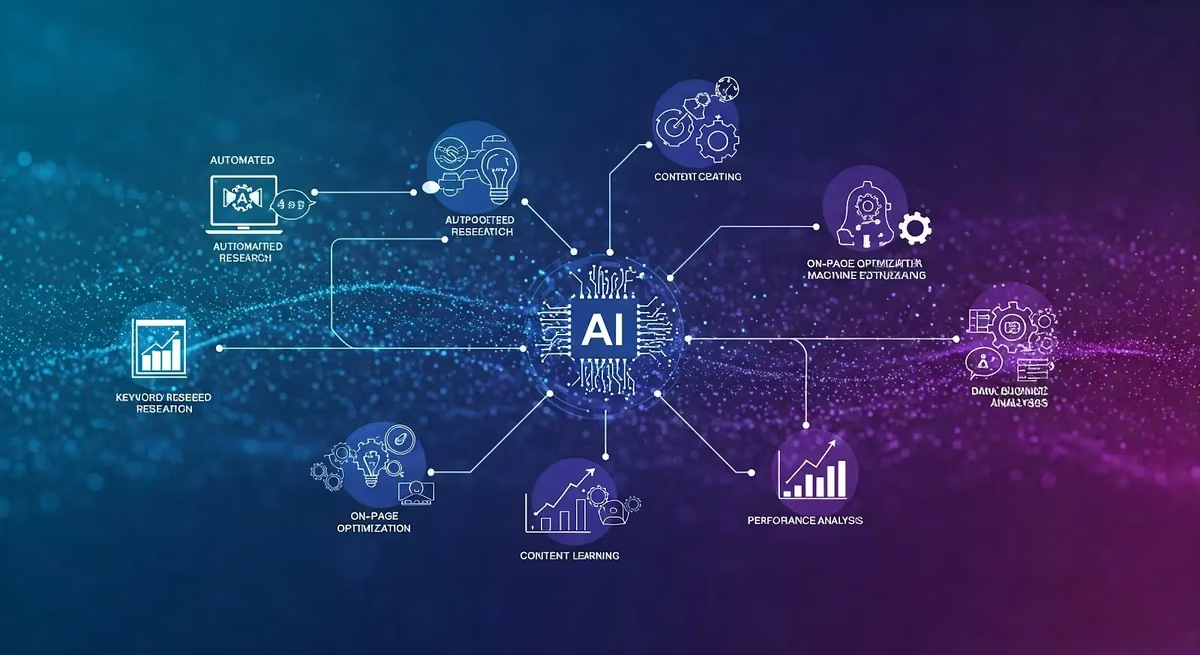
Marketers need an AI-driven workflow to stay ahead. Here’s a step-by-step AI-powered SEO workflow:
Step 1: Research with AI-Driven Insights
Use AI SEO tools (MarketMuse, Frase, SEMrush AI) to analyze search trends and predict intent shifts.
Let AI generate content outlines based on top-performing content.
Step 2: AI-Powered Content Creation
Use AI (like Gryffin’s content automation) to generate SEO-friendly drafts.
Ensure AI suggests relevant entities, subtopics, and internal links.
Step 3: On-Page Optimization with AI
Use AI to analyze semantic relevance and topic completeness.
Implement schema markup automatically using AI-based plugins.
Step 4: AI-Powered Link Building
AI tools identify high-authority sites for topical backlinks.
Predictive AI suggests which content to update for better rankings.
Step 5: Continuous AI-Powered Monitoring
Use AI to track SEO performance in real-time.
AI provides automated recommendations to adjust content dynamically.
How AI SEO search intent will reshape content and discovery
SEO is no longer about matching words—it’s about matching meaning, context, and intent.
AI is transforming search intent analysis, semantic SEO, and conversational AI—pushing marketers to focus on real user needs instead of outdated keyword strategies.
To stay ahead:
Use AI-powered tools to track search behavior in real time.
Optimize for voice, visual, and predictive search.
Leverage AI to create intent-driven, chatbot-ready content.
AI is not just helping SEO—it’s redefining it. Will your strategy evolve with it?
Use Gryffin AI to manage clustering, schema, and updates for AI SEO search intent
Gryffin’s AI-powered marketing automation platform takes the guesswork out of SEO, enabling you to:
Streamline Content Creation – Generate SEO-friendly content using customizable AI-powered templates tailored to your brand and audience.
Optimize with AI-Driven Insights – Leverage Gryffin’s AI to suggest content improvements, structure topic clusters, and refine on-page SEO dynamically.
Automate SEO Workflows – From content ideation to publishing, Gryffin helps you manage your entire SEO workflow efficiently—so you can focus on growth.
Scale Content Production – Need to generate blog posts, social media content, and landing pages at scale? Gryffin’s multi-channel content automation has you covered.
Seamlessly Integrate with Your Marketing Tools – Sync with Google Analytics, Google Search Console, and other platforms to track content performance and refine your strategy in real time.
Q: What is semantic SEO, and why are keywords alone not enough in modern search? A: Semantic SEO focuses on topic relevance, entity relationships, and content depth rather than exact-match keywords. AI models interpret intent and context using signals like device, location, and behavior, so content must address user needs comprehensively. Use topic clusters, related terms, and structured data to align with how search engines now understand meaning.
Q: How do Google’s BERT, MUM, and RankBrain change how I should approach search intent and content? A: BERT helps search engines understand natural language and context, MUM interprets text, images, and video to answer complex, conversational queries, and RankBrain learns from user interactions to refine results. Prioritize intent-first content that covers related subtopics, uses clear language, and includes entities and schema. Write in a conversational style and target featured snippets and voice answers.
Q: Can you outline an AI-powered SEO workflow from research to creation, on-page, links, and continuous monitoring? A: Start with AI-driven research using tools that analyze trends, intent shifts, and top-performing content to generate outlines. Create drafts with AI that suggest relevant entities, subtopics, and internal links. Optimize on-page with semantic analysis and automated schema, then use AI to identify topical backlink prospects and update opportunities. Monitor performance in real time and refresh content dynamically based on AI recommendations.
Q: How do I build pillar pages and topic clusters with AI, including smart internal linking? A: Use AI to map related topics and entities, then structure a pillar page that answers the core query with supporting articles covering subtopics in depth. AI can model the cluster hierarchy and propose internal links that connect each subtopic back to the pillar. Organize content around entities aligned with the Knowledge Graph to signal authority and coverage.
Q: Which AI tools help with content scoring, automated clustering, internal linking, and schema markup? A: MarketMuse, Frase, and SEMrush AI provide content scoring, outline generation, and semantic gap analysis. Gryffin AI supports content automation, topic cluster structuring, and dynamic on-page optimization. For schema, use AI-based plugins to generate and manage structured data, and rely on AI content tools to surface internal linking suggestions at scale.
Q: What does predictive SEO look like, and how can I use AI to forecast search trends 3–6 months ahead? A: Predictive SEO uses AI to scan news, industry chatter, and search behavior to forecast rising topics and shifting intent. Track early signals, prioritize emerging queries with growth potential, and publish ahead of competitors. Pair this with historical data modeling for seasonal patterns and build evergreen assets you can refresh as intent evolves.
Q: Practical steps to optimize for voice, visual, and conversational search, including schema and featured snippets. A: Write in natural, question-based language and add concise answers to target voice results and featured snippets. Implement structured data (FAQ, HowTo, Product) and ensure pages load fast on mobile. For visual search, use high-quality images, descriptive alt text, and image schema. Create conversational, chatbot-friendly pages with clear FAQs and entity-rich context.
Q: How can AI analyze top-ranking pages and suggest real-time content updates and gap fixes? A: AI scrapes SERPs to extract common entities, related terms, and phrase patterns, then scores your content against top results. It flags missing subtopics and recommends rewrites or new sections to close gaps, updating as behavior and trends shift. In practice, adding missing phrases like “machine learning in digital marketing” and “predictive analytics tools” has driven meaningful ranking and traffic gains.
Q: My keyword-focused pages are slipping—how do I shift to intent-driven, semantic content that aligns with user needs? A: Reframe pages around user intent layers (informational, navigational, transactional, and comparative) and expand coverage with related entities and subtopics. Group articles into pillar-and-cluster structures, implement schema, and add smart internal links to signal depth. Use AI gap analysis to update content continuously rather than relying on one-time keyword edits.
Q: Give me an example topic cluster for “AI in digital marketing,” with a pillar page and supporting articles. A:
Pillar Page: “AI in Digital Marketing: A Comprehensive Guide” covering use cases, benefits, and core technologies.
Supporting Articles:
“How AI Powers Personalized Marketing Campaigns”
“The Role of AI in SEO and Search Intent Optimization”
“AI-Generated Content: How Brands Are Leveraging Automated Copywriting”
“Chatbots and AI-Driven Customer Service: The Future of Engagement”
At first, we weren’t even thinking about AI visibility. We were focused on rankings and traffic like everyone else. But once we started testing our brand in ChatGPT and other AI tools, we realized we were barely showing up — even for topics we ‘ranked’ for. Gryffin gave us a clear picture of where we stood, how competitors were being cited instead, and what that actually meant for our pipeline. It shifted how we think about search entirely.










.webp)